
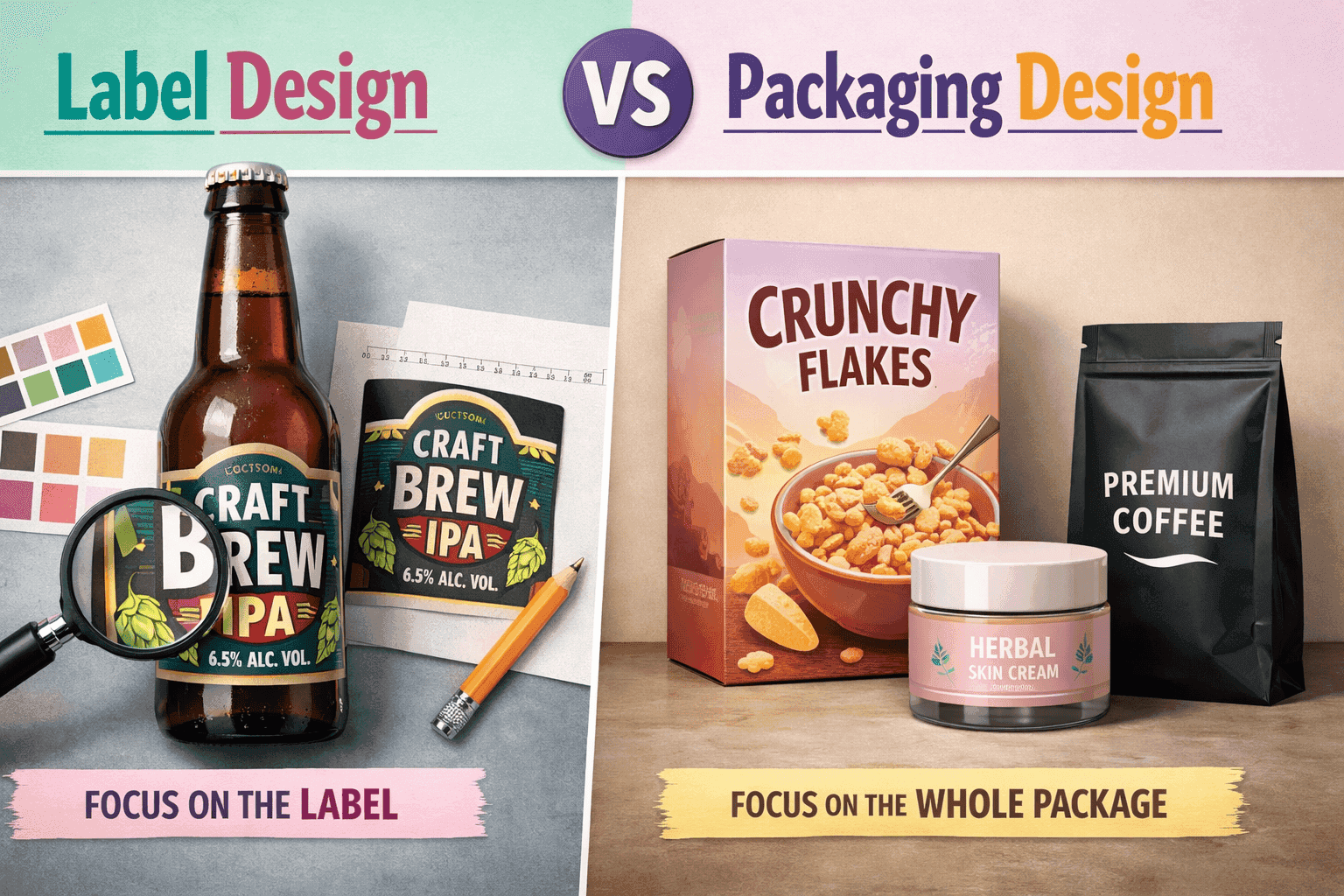
What is Label Design?
Label design refers to the visual and written elements displayed on a product or its packaging. It helps customers identify the product, understand its contents, and recognise the brand. A well-designed label communicates essential information clearly while maintaining brand consistency.
Label design includes:
- Product name and variant
- Brand name and logo design
- Ingredients, usage instructions, warnings
- Barcodes, QR codes, certifications
- Legal and regulatory text
- Visual hierarchy for readability
Types of Label design
There are several types of label design, categorised based on purpose, product type, and branding requirements:
1. Brand labels
The brand labels are designed to be easily recognisable by consumers based upon their brand names and logos and thereby assist with brand identification, allowing consumers to purchase products that correspond to their previous experience with a particular brand. This label provides the framework for success in overall branding services strategy.
2. Descriptive labels
A descriptive label gives consumers a better understanding of the product by detailing the product's characteristics and its contents. The descriptive label also informs consumers of how to use the product and provides ingredient information.
3. Informative labels
Informative labels establish a level of additional information through nutritional information and safety warnings, allowing the consumers to make knowledgeable choices about the product and affording consumers the clarity and compliance.
4. Grade labels
Grade labels provide consumers with an understanding of the quality of a product as it relates to set standards. It promotes consumer confidence in a brand by giving consumers an easy way to evaluate and compare similar products.
What is Packaging Design?
Packaging design refers to the structure, materials, and overall appearance of a product’s container. It focuses on protecting the product, improving usability, and creating a strong shelf presence. Packaging design also plays a major role in customer experience, transportation, and storage.
Packaging design includes:
- Box, carton, pouch, bottle or container structure
- Materials, finishes, textures
- Color systems and fonts
- Easy opening and closing
- Protection, shipping and storage considerations
- Shelf appearance and unboxing feel
Material of Packaging Design
Packaging design is to keep the product safe and secure when packaged for retail distribution in various boxes, containers, and wrapper styles. Packaging is made with many types of materials, including:
1. Metal
Metal is one of the strongest, most durable packaging materials. Most metal packaging is made of either steel or aluminium, and it is typically used for cans, tins, and specific containers that require additional protection. Metal provides excellent moisture and air barrier properties, and it can be recycled; therefore, it is very useful in product packaging design.
2. Paper
Paper is a light and flexible packaging material that can break down naturally. It is mainly used to make boxes, bags, wrapping paper, and custom packaging. Paper packaging is low-cost and eco-friendly, but it is not as strong or long-lasting as some other packaging materials.
3. Styrofoam
Styrofoam is a very light packaging material that gives good insulation and protection to products. However, it does not break down naturally and is harmful to the environment, making it one of the most damaging packaging materials for nature.
4. Plastic
Plastic is a flexible and lightweight material for making or packaging bottles, containers, and wraps. While durable and resistant to moisture, and therefore advantageous in developing packaging, it is environmentally problematic due to its non-biodegradable characteristics.
5. Corrugated/cardboard
Corrugated cardboard is very strong and lightweight, which makes it a great option for use as an outer package or shipping material. It offers good protection during storage and transportation of an item; this type of material can easily be recycled or composted as well as being biodegradable.
6. Cellophane
Cellophane is a clear packaging material made from natural cellulose. It is mostly used for food packaging. Cellophane is biodegradable and helps protect products from moisture while also allowing customers to see the product inside without opening the package.
7. Cloth
Cloth made from natural or synthetic fibres is commonly used to produce reusable bags and also protect your products from outside influence. The durability of cloth as an option for protective packaging is good because it can be cleaned and reused many times and is therefore a viable eco-friendly option.
8. Wood
Wood is considered a renewable and sustainable material that can be used to create crates, pallets and specialised packaging. It provides superior protection and can be reused many times. It is heavy and bulky compared to other packaging materials.
9. Polythene
Polythene is a flexible plastic product used for packaging in the form of bags, shrink wraps, and liners. It is an inexpensive and waterproof product but is non-biodegradable and raises environmental issues.
Types of Packaging Design
Packaging design is classified into three types: Primary, Secondary and Tertiary Packaging. Each type plays a crucial role in creating an effective product packaging design.
1. Primary packaging
Primary packaging comes into direct contact with the product and is solid along with it. It serves as the first layer of protection and commonly includes bottles, cans, wrappers or containers.
2. Secondary packaging
Secondary packaging provides an additional layer of protection, particularly for fragile products. It groups multiple primary packages together and is usually removed after purchase.
3. Tertiary packaging
Tertiary packaging includes pallets, shrink wraps and shipping containers used for bulk handling, storage and transportation. It ensures product safety using logistics and distribution stages of the packaging design process.
Label Design vs Packaging Design: Key Differences Explained
The table below clearly explains the difference between label design and packaging design based on purpose, materials, creativity, and customer impact.
| Basis | Label design | Packaging design |
|---|---|---|
| Definition | Label design means adding pictures and information on a product or its package. | Packaging design is to ensure the security and packaging of the product inside the package. |
| Purpose | The purpose of a label is to provide important product-related information they need to make an informed purchasing decision. | Packaging protects the product and keeps it safe during transport, storage, and sale. |
| Materials | Labels are usually made from paper, plastic, or metal based on where they are used. | Packaging uses materials like paper, cardboard, plastic, metal, glass, and wood for strength and safety during the packaging design process. |
| Designing and creativity | Label design is simple and clear, using easy-to-read fonts and layouts. | Packaging design is more creative and structured, helping the product look attractive on shelves. With the help of brand consultancy. |
| Customers' buying approach | Label design mainly influences customer understanding, while packaging design strongly affects first impressions and buying decisions. | Packaging has a strong influence on buying decisions, as many consumers choose products based on attractive packaging and presentation. |
| Safety | Labelling improves safety by providing warnings, precautions, and correct usage instructions to prevent misuse or harm. | Packaging ensures product safety by protecting it from physical damage, contamination, and tampering during storage and transportation. |
| Legal requirements | Labelling must comply with regulations that control how product information like ingredients, expiry dates, and manufacturer details are displayed to ensure consumer protection. | Packaging must follow specific rules related to materials, size, strength, and weight, depending on the product type and country of sale. |
| Environmental impact | Labels usually create less waste because they use less material. | Packaging can harm the environment if it is not recyclable or reusable. |
Conclusion
Label design and packaging design serve different but equally important roles in branding. Label design ensures that customers receive clear product information and brand recognition, while packaging design focuses on protection, usability, and visual appeal. When both are planned strategically, they help create a consistent brand experience and influence customer purchasing decisions.