
This happens every week in solar businesses across Kerala, Tamil Nadu, Karnataka, and the rest of South India. The solar market in India is growing fast — really fast. But if your team is tracking leads on WhatsApp and Excel sheets, you are going to keep losing deals to competitors who are simply more organised.
That is where a CRM for solar comes in. It is not complicated software. It is just a smarter way to manage your leads, follow up on time, and make sure no customer falls through the cracks. This guide explains what solar CRM software is, what it does, and how to pick the right one for your business in India.
What Is a CRM for Solar Business?
CRM stands for Customer Relationship Management. But do not let that formal name confuse you. Think of it as a digital notebook — one that never forgets. Every lead you get, every call you make, every follow-up you plan, every proposal you send — all of it is stored in one place. And the system reminds you what to do next.
A regular CRM (like the kind banks or insurance companies use) is built for simple sales. You talk to a customer, send a quote, and that's it.
Solar is different. Your sales process has many steps:
- Customer inquiry comes in
- You call and qualify the lead
- You schedule a site visit
- You do a roof survey and check the electricity bill
- You design the system and prepare a proposal
- Customer approves
- You arrange financing if needed
- Installation happens
- Net metering / DISCOM approval is sorted
- After-sales support begins
A general CRM does not know about these steps. A CRM built for solar business does. It tracks where each customer is in this journey and tells your team exactly what needs to happen next.
What Can Solar CRM Software Actually Do?
Here is a plain-English breakdown of what good solar CRM software does for your business every day.
Capture and Track Every Lead
When a new lead comes in — from your website, a Facebook ad, a referral, or a trade show it goes straight into the CRM. No more noting names on paper or in a WhatsApp chat that gets buried. Every lead has its own record with the customer's name, phone number, location, and where they came from. You can see at any time how many leads you have and which ones need attention today.
See Your Entire Sales Pipeline at a Glance
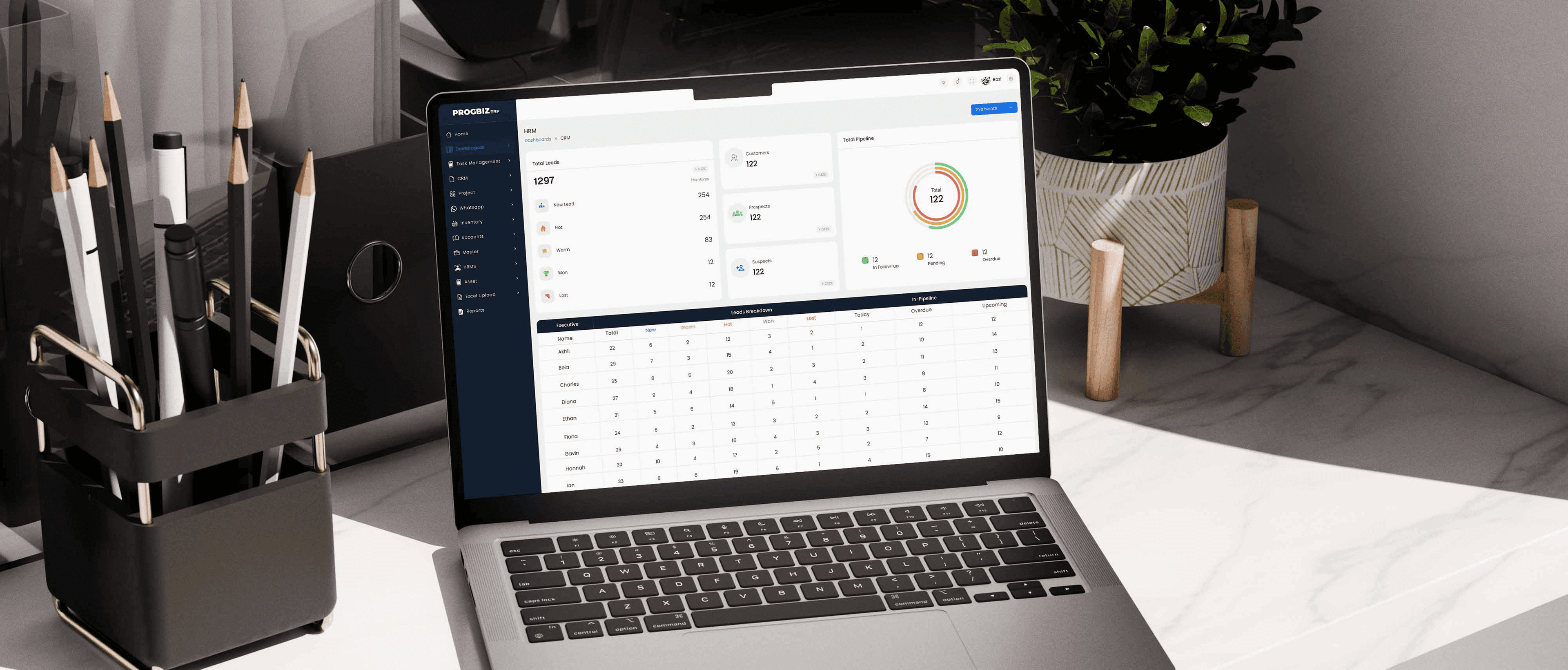
Imagine opening your laptop in the morning and seeing every deal your team is working on all of them, on one screen. New leads on the left. Site visits scheduled in the middle. Proposals sent on the right. Deals won at the end. This view is called a sales pipeline, and it is one of the most useful things a CRM gives you. You always know what is happening in your business without asking anyone.
Send Follow-Up Reminders Automatically
The number one reason solar companies lose deals is slow follow-up. A customer asks for a quote on Monday. If you don't follow up by Wednesday, they move on. With a CRM, you set a reminder or the system sets one for you. Your salesperson gets a notification: "Call Rajan in Thrissur today — he requested a quote 2 days ago." No lead gets forgotten.
Create and Send Proposals Quickly
Every solar company knows this problem. A customer asks for a proposal and it takes 2–3 days to put one together. By that time, another company has already sent theirs. A good CRM helps you create proposals faster using ready-made templates. You just fill in the system size, price, and customer name and send it in minutes.
Schedule Site Surveys Without Confusion
Who is going for the site visit? When? Has the customer confirmed? Without a system, this gets messy fast — especially when you have 2 or 3 site visits in a day across different areas. A CRM lets you assign the visit to a team member, set the time and date, and send a reminder to both the team and the customer. Everything is clear and no one shows up at the wrong place.
Track the Project After the Sale
Closing the deal is not the end. Installation needs to be scheduled. Materials need to be ordered. The DISCOM application needs to go in. Net metering needs to be sorted. A solar business management tool tracks all of this. Every project has its own checklist. Your team knows what is pending, and you can check progress without calling everyone.
Get Reports That Actually Make Sense
How many leads did your team get last month? How many converted? Which salesperson is closing the most deals? Which city is giving you the most business? A CRM gives you this data without you having to build an Excel formula. Clear reports, simple numbers, useful information so you can make better decisions for your business
Why Indian Solar Companies Especially Need a CRM
The solar market in India — especially in Kerala, Tamil Nadu, Karnataka, and Andhra Pradesh is growing faster than most businesses can handle. Government schemes, rising electricity bills, and better awareness have all pushed demand up sharply.
But most solar businesses in India are still running on:
- WhatsApp group chats with the sales team
- Excel sheets that only one person understands
- Physical notebooks for site visit notes
- Someone's memory for follow-up dates
This works when you have 5 or 6 customers a month. But when you start getting 30, 40, or 50 inquiries a month, it falls apart.
Without a CRM, here is what typically goes wrong:
- A lead comes in on Saturday and nobody follows up until Tuesday — by then, they've moved on
- Two salespeople call the same customer on the same day because there's no shared record
- A promising lead from three weeks ago is forgotten because it got buried in WhatsApp
- You have no idea which marketing channel is actually bringing in customers
With a CRM for solar business, all of this changes. Every lead is assigned. Every follow-up is tracked. Every deal is visible. Your whole team is working from the same system, not from their own personal notes.
What to Look for in a CRM for Solar Business in India
Not every CRM will work for a solar company in India. Here is what to check before you pick one:
- Works well on mobile — your sales team and site survey staff are always on the move. The CRM must work properly on a phone, not just a laptop.
- Affordable pricing — you are not a bank or an airline. You need something priced for a small or mid-size Indian business.
- WhatsApp and email integration — most of your customer communication happens on WhatsApp. A good CRM should connect with it.
- GST-ready invoicing — you need to send GST-compliant quotes and invoices without switching to another tool.
- Cloud-based — your team in Kochi and your office in Kozhikode should both see the same data in real time.
- Solar-specific pipeline stages — the CRM should already understand stages like Lead → Site Visit → Proposal Sent → Deal Won → Installation → Handover. You should not have to build this from scratch.
- Simple setup — you should not need a full-time IT person to set it up or maintain it.
Affordable CRM Options for Small Solar Companies in India
A lot of small solar companies in India assume CRM software is either too expensive or too complicated. That thinking made sense five years ago. It does not anymore.
Tools like Salesforce, SAP, or Microsoft Dynamics are built for large corporations with hundreds of salespeople. They take months to set up, cost lakhs per year, and require dedicated IT support. A solar company with 5 to 20 people does not need any of that.
Today, there are simple, affordable CRM tools built specifically for Indian small and medium businesses — and they work really well for solar companies.
One option worth looking at is Progbiz. It is a CRM software for solar businesses built with Indian businesses in mind. The setup is simple, the interface is clean, and your team can start using it the same day. It handles lead management, follow-up reminders, pipeline tracking, and reporting — everything a growing solar company needs — without the price tag of an enterprise tool. Solar companies across South India are already using it to manage their leads and projects more effectively
Best CRM for Solar Companies in Kerala
Kerala has one of the highest rooftop solar adoption rates in the country. KSEB's net metering programme, the PM Surya Ghar scheme, and strong public awareness have all contributed to a sharp rise in demand — especially in cities like Thiruvananthapuram, Kochi, Kozhikode, and Thrissur.
If you run a solar company in Kerala, you are probably getting more inquiries than you were two years ago. That is good news. But it also means more leads to track, more site visits to coordinate, and more proposals to send out.
Many Kerala solar installers are still managing all of this manually. A customer calls on Monday, someone notes it in a register, and by Thursday, the lead is cold because nobody followed up.
A good CRM solves this. You can track every inquiry from the first call to the final installation. Your team gets daily reminders. No lead is left waiting.
Progbiz offers CRM software in Kerala that is already being used by businesses in the state. If your solar company is in Kerala and you want to stop losing leads to slower follow-up, this is worth checking out.
CRM for Solar Companies in Chennai and Tamil Nadu
Tamil Nadu is one of India's top states for solar energy. The state government has been pushing both rooftop and utility-scale solar hard, and the results show. Chennai, in particular, is seeing strong demand from commercial buildings, factories, IT parks, and large housing societies. This is a big opportunity. But managing multiple commercial projects across a city like Chennai is not simple. You have different customers at different stages. Multiple site engineers running around. Follow-ups pending with five different clients. Payment milestones to track. And a team that needs to stay coordinated across locations.
Spreadsheets and group chats will not cut it at this scale.
Solar companies in Chennai need a proper system for:
- Tracking each project from inquiry to handover
- Keeping client communication organised in one place
- Assigning tasks to team members and following up
- Managing payment collection and invoicing
Progbiz provides CRM software in Chennai that helps growing solar businesses in Tamil Nadu do exactly this — without needing a big IT budget or weeks of training.
Why Progbiz CRM Works Well for Solar Businesses
There are many CRM tools in the market, but most of them are either too big, too expensive, or not built with Indian solar companies in mind.
Progbiz is different. It is a CRM built for Indian businesses — the kind of companies that are growing fast but do not have the budget or the team for complex enterprise software.
For a solar company, Progbiz gives you:
- A clean pipeline view so you can see every deal at a glance
- Lead capture from multiple channels in one place
- Automatic follow-up reminders so your team never misses a call
- Proposal and quotation management to send quotes faster
- Project tracking after the sale so installation stays on schedule
- Reports that show you where your business stands without building a single formula
The setup is quick. Your team can start using it within a day. And the pricing is designed for small and growing businesses — not large corporations.
If you want to see how it works for a solar business, you can explore it here: CRM software for solar business