
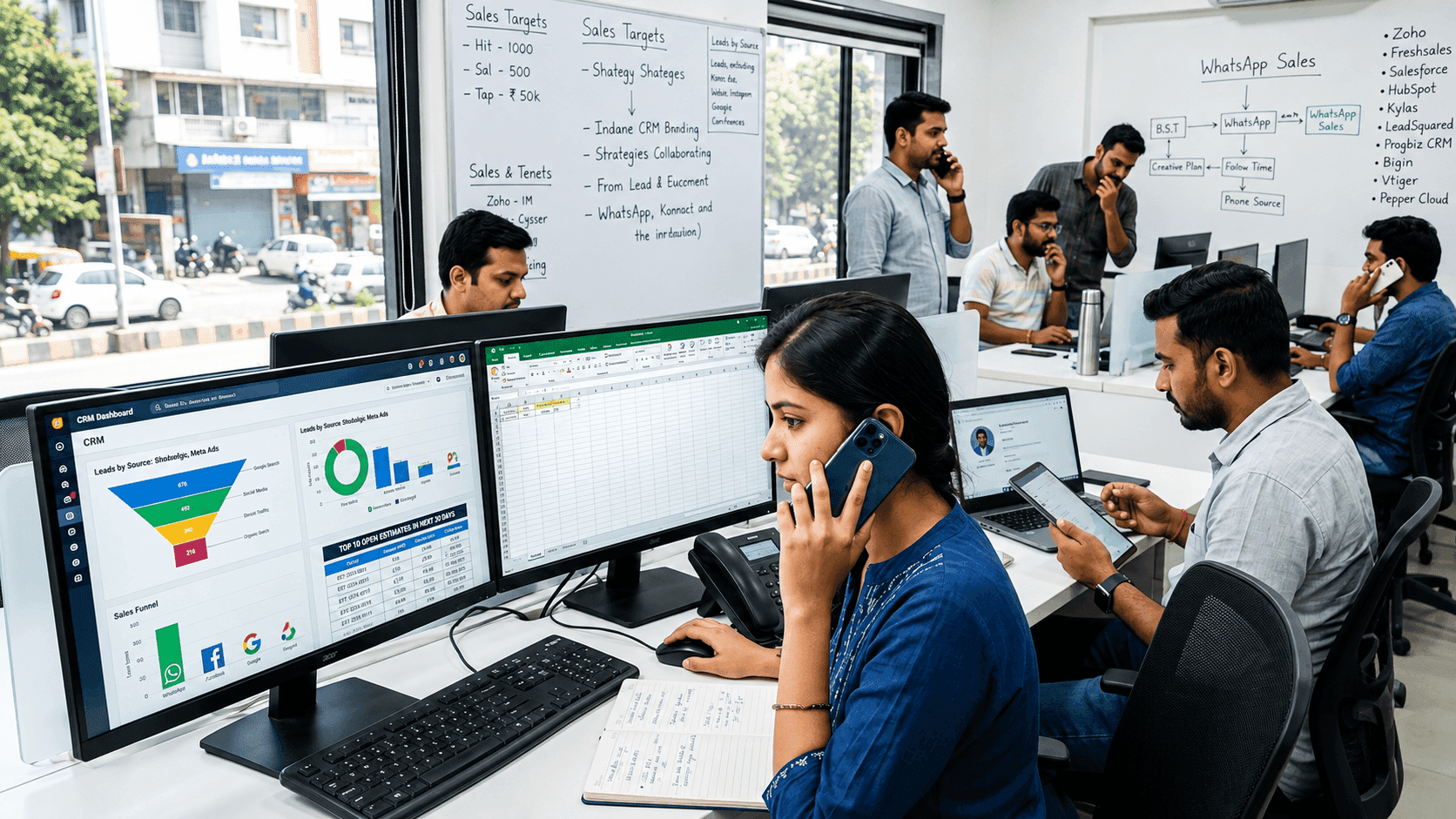
This guide compares the top 10 CRM software in India for 2026, from Indian-built platforms like Zoho CRM, Freshsales and Kylas to global names like Salesforce and HubSpot. It is written for small and medium businesses, startups and growing sales teams — especially those currently managing leads through WhatsApp chats, phone calls and spreadsheets, and looking for a system that fits how Indian businesses actually sell.
How We Selected These CRM Software
Every platform on this list was assessed against ten criteria that matter to Indian buyers: pricing and affordability in rupees; ease of implementation; lead management; sales pipeline management; automation; WhatsApp and customer-communication capabilities; mobile accessibility; customer support; scalability; and overall suitability for Indian businesses.
Two things to be clear about. First, this is not an independently audited ranking — Progbiz CRM is our own product and appears first; the remaining nine are ordered to cover the spread of budgets, team sizes and selling styles Indian businesses typically compare. Second, every pricing figure was checked against the vendor’s official pricing page or verified listings in August 2026 and date-stamped, because CRM price lists change often. Where a vendor does not publish prices, we say so instead of guessing.
The goal is simple: help you shortlist two or three CRMs worth testing with your own leads — including, where it fits, ours.
Progbiz CRM
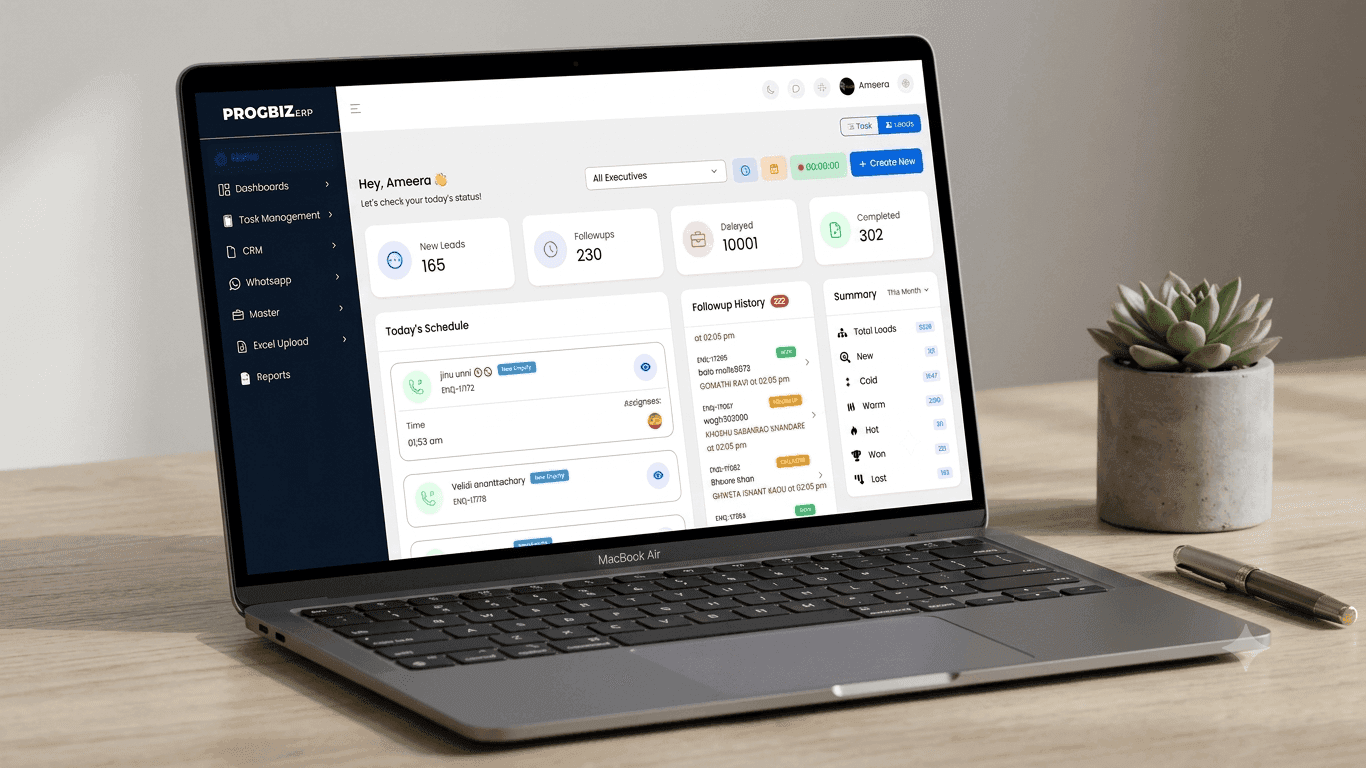
Progbiz CRM is a sales CRM built by Progbiz, a software company based in Kannur, Kerala, for Indian small and medium businesses. It concentrates on the stage where most Indian SMBs lose revenue: capturing every enquiry that comes in — from WhatsApp, Facebook ads, Google ads, calls and the website — and making sure every one of them is followed up on time.
Why Indian Businesses May Consider Progbiz CRM
The typical Indian sales day is messy. Ad leads land at 11 pm, enquiries arrive as WhatsApp messages, the field team is out on visits, and follow-ups live in someone’s head or a spreadsheet that was last updated on Tuesday. Progbiz CRM is built around that reality: leads flow into one pipeline automatically, follow-ups and reminders are triggered without anyone having to remember them, and managers can see what is actually moving toward closure.
The other reason is proximity: the product is built, implemented and supported from India, in Indian hours. Talking to the people who set up your CRM — instead of raising tickets with a desk in another time zone — changes how fast the system gets adopted.
Key Features
- Lead capture and management — capture leads automatically from Facebook, Google and WhatsApp through webhook integrations, with source tracking, automatic assignment and smart filters to segment your pipeline.
- Sales pipeline — visual pipeline and funnel views, quote management for sending and tracking proposals, and loss-reason tracking so you learn why deals slip, not just that they did.
- Follow-up management — automated follow-ups and reminders, so the 11 pm ad lead gets attention before a competitor reaches them in the morning.
• Reporting — dashboards and sales reports, including ad ROI tracking that connects revenue back to the campaign that produced it — useful if Meta and Google ads are your main lead source.
• Mobile and access control — iOS and Android apps for field teams, with role-based data security so team members only see the data they are authorised to see.
• Integrations and customisation — works with Gmail, Outlook, WhatsApp and Slack, with customisable fields and workflows to match how your business sells.
Pricing
Progbiz CRM is offered on separate SMB and Enterprise plans with India-focused pricing in rupees; exact pricing is shared on enquiry rather than published as a rate card. The practical way to evaluate cost is to book a Progbiz CRM demo and get a quote for your team size alongside the walkthrough.
Best For
Indian small and mid-sized businesses moving from Excel, Google Sheets or WhatsApp-only lead tracking to a proper system; businesses that run Meta or Google ads and lose leads in the handover; teams with field sales staff who work from their phones; and businesses that want implementation and support from a local team rather than documentation and ticket queues.
Who May Not Need Progbiz CRM
Honest answer: if you need a large third-party app marketplace, deep built-in marketing automation, or multi-region enterprise governance, platforms like Salesforce or Zoho’s higher tiers are built for that scale and Progbiz CRM is not trying to be. Similarly, teams that want AI-led lead scoring as a live feature today will find it in Freshsales or Zoho Enterprise; AI assistance in Progbiz CRM is on the roadmap rather than in the product.
Why Choose Progbiz CRM?
Three practical reasons. It is built around how Indian SMBs actually receive leads WhatsApp, Facebook and Google first, not email first. It comes with local, IST-hours implementation and support from the team that builds it. And Progbiz also builds ERP software, so a business that outgrows standalone CRM can extend into inventory, accounts and operations with the same vendor instead of migrating everything.
Explore Progbiz CRM or book a free demo to see whether it fits your sales process bring your real lead sources to the call and have the team map them live.

See it running on your own leads
A 20-minute walkthrough with the team that builds it. Bring your real lead sources, WhatsApp, Meta ads, Google, and we'll map them live.
 Book a free demo
Zoho CRM
Zoho CRM is the flagship CRM from Zoho, the Chennai-founded software company, and the most widely adopted CRM among Indian SMBs. It covers lead and contact management, workflow automation, forecasting and advanced analytics, and connects to the broader Zoho ecosystem of 45+ business apps.
Best for: small businesses to mid-market teams that want serious feature depth and configurability at Indian prices.
Pricing (Aug 2026): free edition for up to 3 users; paid plans at ₹800 (Standard), ₹1,400 (Professional), ₹2,400 (Enterprise) and ₹2,600 (Ultimate) per user per month, billed annually, plus GST.
Strengths: the strongest price-to-feature ratio in its class, rupee billing with a GST invoice, and an ecosystem that grows with you.
Consider: configuration takes real effort — many teams engage a Zoho partner to implement it well, and AI features (Zia) only begin at the Enterprise tier.
Salesforce
Salesforce is the global CRM market leader. Its Sales Cloud and Starter Suite editions cover the full spectrum from small-team pipeline management to deeply customised enterprise sales operations, backed by the AppExchange marketplace and a large partner network in India.
Best for: large or fast-scaling sales organisations with complex processes, dedicated admins and integration-heavy stacks.
Pricing (Aug 2026): Starter Suite at $25 per user per month, Pro Suite at $100, Enterprise at $165 and Unlimited at $330, billed annually. Indian customers are billed in USD, so the rupee cost moves with the exchange rate. A 30-day free trial is available.
Strengths: unmatched customisation, reporting and third-party ecosystem; the platform large enterprises standardise on.
Consider: for most Indian SMBs, the licence cost plus partner-led implementation (often running into lakhs) buys more platform than the team will use.
HubSpot CRM
HubSpot pairs a genuinely useful free CRM with paid Sales, Marketing, and Service hubs. It is known for being easy to adopt teams are usually productive within days and for tight alignment between marketing content and sales follow-up.
Best for: startups and inbound, content-led teams that want marketing and sales working from one database.
Pricing (Aug 2026): free tools (up to two users on new accounts); Sales Hub Starter at around $20 per seat per month; Professional at $100 per seat and Enterprise at $150 per seat. Billing is in USD.
Strengths: ease of use, a free tier that is a real product rather than a teaser, and excellent onboarding content.
Consider: costs climb steeply once you need Professional-tier automation, and there is no rupee billing.
LeadSquared
LeadSquared is a Bengaluru-based sales execution platform built for high lead-volume, high-velocity selling. It combines CRM with lead distribution, telephony integrations, WhatsApp Business API messaging, field-force tracking and marketing automation, with vertical solutions for EdTech, education, BFSI, healthcare and real estate.
Best for: businesses running large telecalling or field teams where a lead must be dialled within minutes of arriving.
Pricing (Aug 2026): tiered plans (Lite, Pro, Super) sized by users and contact volume; current pricing is quoted by the sales team rather than published — check the official pricing page.
Strengths: workflows genuinely designed for Indian high-velocity industries, strong mobile field features and deep Indian telephony integrations.
Consider: it is built for scale — a five-person sales team will likely pay for operational depth it never uses.
Freshsales by Freshworks
Freshsales is the sales CRM from Freshworks, the Chennai-headquartered SaaS company. It stands out for a clean, modern interface, built-in phone and email, and Freddy AI for lead scoring and insights — a CRM that works well out of the box without a long configuration project.
Best for: SMBs that value usability and want calling, email and WhatsApp conversations inside the CRM from day one.
Pricing (Aug 2026): free plan for up to 3 users; paid plans start at $9 per user per month billed annually, with rupee billing available for Indian customers; 21-day free trial.
Strengths: ease of use, built-in calling and AI features at accessible tiers.
Consider: several essentials — multiple pipelines, sales sequences — sit in higher tiers, and add-ons like chatbot sessions and call minutes can add up.
Kylas
Kylas is a Pune-built sales CRM designed specifically for growing Indian businesses, with one unusual decision at its core: flat pricing with unlimited users. It includes lead capture from portals and Facebook lead ads, built-in WhatsApp messaging, pipeline management and sales automation, with onboarding and training by CRM experts included in the plan.
Best for: growing teams that keep adding salespeople and are tired of doing per-user licence math.
Pricing (Aug 2026): free plan with limited records; Elevate at a flat ₹12,999 per month with unlimited users; Exceed from ₹75,000 per month for larger requirements.
Strengths: completely predictable cost as headcount grows, and included onboarding — a real advantage for first-time CRM adopters.
Consider: for very small teams the flat fee works against you — below roughly 15 users, per-user plans like Zoho Standard or Bigin usually cost less; plans also carry record-count limits.
Bigin by Zoho
Bigin is Zoho’s pipeline-first CRM for very small businesses — deliberately minimal, closer to a smart, structured replacement for the sales spreadsheet than a full CRM suite. It covers contacts, pipelines, basic automation and email, with mobile apps included.
Best for: solo founders and teams of two to ten adopting a CRM for the first time.
Pricing (Aug 2026): free plan for one user; Express at ₹400 per user per month billed annually — the official India price — with Premier and Bigin 360 tiers above it.
Strengths: the lowest credible paid entry price in India, near-zero learning curve, and a clean upgrade path into full Zoho CRM when you outgrow it.
Consider: it is intentionally lightweight — advanced automation, reporting and customisation are exactly what it leaves out.
Vtiger CRM
Vtiger is a Bengaluru-origin CRM with open-source roots and an all-in-one philosophy: sales, help desk, marketing and even inventory and invoicing modules in a single platform, unified by its One View of the customer.
Best for: teams that want sales and customer support running on one system without buying two products.
Pricing (Aug 2026): One Pilot free plan for up to 10 users and 3,000 records; One Growth at $12 per user per month, with Professional, Enterprise and AI tiers above. A self-hosted open-source edition also exists.
Strengths: exceptional breadth for the price, and open-source flexibility for businesses that want control.
Consider: the interface feels less polished than newer rivals, and configuring the full suite properly takes time.
Pepper Cloud
Pepper Cloud is a Singapore-headquartered sales CRM for SMEs, sold into India among other markets, built around messaging-first selling: an omnichannel inbox for WhatsApp, Facebook and Instagram, WhatsApp broadcasts and campaigns, an AssistAI chatbot for lead capture, and standard pipeline management underneath.
Best for: sales teams whose deals genuinely live inside WhatsApp conversations.
Pricing (Aug 2026): Starter, Business and Enterprise plans; list prices are not published — pricing is shared on request, with a trial available.
Strengths: among the deepest WhatsApp-selling feature sets in the category, including multi-device access and campaign tools.
Consider: implementation and support come from outside India, and budgeting requires a sales call since prices are not public.
How to Choose the Right CRM Software in India
The pattern behind most failed CRM purchases in India is the same: the software was chosen on features, not on fit. Work through these seven checks before you commit.
- Define your business size and sales process first. A two-person team and a forty-person telecalling floor need different products. Write down how a lead travels from enquiry to closure today — that one page shapes your shortlist more than any comparison article.
- Check lead and pipeline management against your real channels. If your leads come from WhatsApp and Meta ads, confirm the CRM captures from those sources automatically — not through manual entry.
- Calculate total cost, not licence cost. Add implementation, customisation, training, add-ons (telephony, WhatsApp API messages) and 18% GST. A ₹800 licence with ₹50,000 of setup is a different decision from a flat-fee plan with onboarding included.
- Evaluate integrations. Email (Gmail or Outlook), WhatsApp, your telephony provider and your accounting or ERP software are the ones that matter for most Indian SMBs.
- Check support and implementation. Who sets it up, in what time zone, and in what language? Poor onboarding not missing features — is the leading cause of abandoned CRMs.
- Consider scalability. Adding users, adding pipelines, and eventually connecting inventory or accounts should be an upgrade, not a migration.
- Test before committing. Nearly every CRM here has a free plan or trial. Run your real leads through your top two choices for two weeks; the winner is usually obvious by day ten.
How Much Does CRM Software Cost in India?
CRM software in India ranges from free plans to roughly ₹400–₹2,600 per user per month for mainstream paid plans, with enterprise platforms and flat-fee models priced differently — and the licence is only part of the true cost. All figures below were verified in August 2026.
Free CRM options are real: Zoho CRM and Freshsales (3 users each), HubSpot’s free tools, Bigin (1 user) and Vtiger One Pilot (10 users, 3,000 records) — genuine starting points that cap users, records or automation quickly.
Per-user monthly plans are the standard model. Entry tiers run from ₹400 (Bigin Express) to ₹800–₹1,100 per user (Zoho Standard, Freshsales Growth); mid tiers from ₹1,400–₹2,600 (Zoho Professional to Ultimate); and global platforms billed in dollars — Salesforce from $25, HubSpot Starter around $20 per seat — cost more in rupee terms and move with the exchange rate. Annual billing is typically ~20% cheaper than monthly.
Flat-fee pricing flips the model: Kylas charges ₹12,999 per month for unlimited users, which beats per-user pricing once teams cross roughly fifteen people. Quote-based pricing (LeadSquared, Pepper Cloud, Progbiz CRM) is sized to your requirement — ask for the all-in figure in writing.
Beyond the licence budget for 18% GST, one-time implementation (anywhere from a few thousand rupees to several lakh for complex rollouts), customisation, training, and usage-based add-ons such as calling minutes or WhatsApp API messages. The honest comparison metric is total cost per user per year in the first year — not the sticker price.
What Should an Indian Business Look for in a CRM?
An Indian business should look for a CRM that captures leads from every channel it actually uses WhatsApp, ad forms, website, calls and then makes follow-up automatic. In practice that means eleven capabilities: lead management, a clean customer database, sales pipeline views, follow-up reminders, communication tracking, reporting, automation, mobile access for field teams, integrations with email, WhatsApp and telephony, responsive support in your working hours, and room to scale. Rupee billing with a GST invoice and implementation help in India are the two India-specific checks that global comparison articles usually skip and the two that most often decide whether the CRM survives contact with a real Indian sales team.
Progbiz CRM vs Other CRM Options
No CRM on this list is best for everyone the honest way to decide is to match the tool to your situation.
Choose Progbiz CRM if:
- You are an Indian SMB whose leads arrive through WhatsApp, Facebook and Google ads, and you want them captured and followed up automatically.
- Local implementation and support matter you want the team that built the product setting it up, in Indian working hours.
- You prefer India-focused pricing quoted for your team size over navigating global rate cards.
- Your team wants a straightforward system it will actually use, not a platform that needs an administrator.
- You may eventually need ERP Progbiz builds that too, so growth does not force a vendor change.
Consider alternatives if:
- You need a large third-party app marketplace or deep multi-region enterprise features Salesforce and Zoho Enterprise are built for that.
- You want live AI-driven lead scoring today Freshsales and Zoho’s upper tiers ship it now.
- You need heavy marketing automation alongside CRM HubSpot’s paid hubs are the specialist choice.
- You run a very large telecalling operation LeadSquared is purpose-built for that scale.
If you sit in the first group, the fastest way to find out is a demo with your real lead sources on the table.