

The 'Hidden' Search Shift: Why Being at the Top of Google Isn't Enough Anymore
A decade ago, an SEO expert would have spent hours finding the exact keywords to match the terms like “best running shoes” because Google rewarded these precise keywords. But search has evolved since then. Today, as we move through 2026, the very meaning of “Googling” has changed; it is no longer about keywords but about context, intent, and intelligent search. Search is now being rewritten by artificial intelligence. AI SEO strategy is no longer a distant concept. It has evolved into the core element that powers how websites receive AI-driven traffic.
As an experienced digital marketing specialist, Progbiz has seen many businesses invest heavily in traditional SEO only to see their visibility evaporate in the face of AI overviews and zero-click searches.
So what is the problem?
Traditional SEO is designed for a world where humans typed queries into a box. Today, AI anticipates needs, synthesizes answers, and delivers them without ever leaving the search page. But things have taken a turn; Gartner predicts organic search traffic could drop 25% by 2026, thanks to chatbots and generative engines stealing the spotlight.
But here is the twist!
This isn’t the death of SEO; it’s the rebirth of it. Businesses that embrace AI search optimization not only thrive but also dominate the market. The 25% drop isn't a loss of traffic; it's a migration of users. If you aren't visible in the AI overview, you're invisible to the modern consumer.
Old-school SEO isn’t just slow—it’s obsolete. If you want to grow in 2026, you need a strategy built for the way people actually search today. We call ours the Progbiz 6S Growth Model. It’s an SEO & AI Growth Framework that puts your goals first, using AI SEO tools to sharpen your results while keeping your brand’s voice front and center. It’s time to move past the old playbook and start winning in the new era of search.
Your 2023 SEO Strategy Can't Solve 2026 Problems
Remember when stuffing a page with "SEO tips" got you to page one?
Well, those days are over!
Traditional SEO, which is focused on backlinks, meta tags, and keyword density, will fail in this AI era because search engines now prioritize context, intent, and trust over rote optimization. According to a 2024 study by SparkToro and Datos, for every 1,000 searches in the US, only 360 result in a click to the open web. This means up to 60% of searches end without a click; a reality driven by Google’s evolution into an 'answer engine' that uses AI summaries to provide instant information. If your content doesn’t match the semantic intent of these AI summaries or sound natural to a searcher, you’re effectively invisible.
What many traditional SEO strategies miss is that AI is not there to “rank” your pages; it synthesizes them. Tools like Google's Search Generative Experience (SGE) and ChatGPT now handle many queries without driving traffic, rendering link-building farms obsolete. Most traditional tactics ignore this, leading to wasted ad spend and flatlining conversions. A marketing strategy specialist like Progbiz sees it daily: Clients clinging to 2010s playbooks lose potential leads to competitors leveraging machine learning in marketing.
On the other hand, without adaptation, you’re betting against the odds. As recently highlighted in an Ahrefs study on AI SEO statistics, success in 2026 depends on more than just keywords. It requires adapting to AI search features, optimizing how we create content, and doubling down on brand signals to stay visible in an AI-driven world. Traditional tactics are overlooking significant opportunities. By shifting to AI-assisted SEO, you can start anticipating what your customers actually need and automate the heavy lifting of data analysis. It moves the focus away from just fighting for a rank and toward actually owning the space where your customers are talking.
The Progbiz 6S Growth Model: Your 6-Step SEO & AI Growth Framework
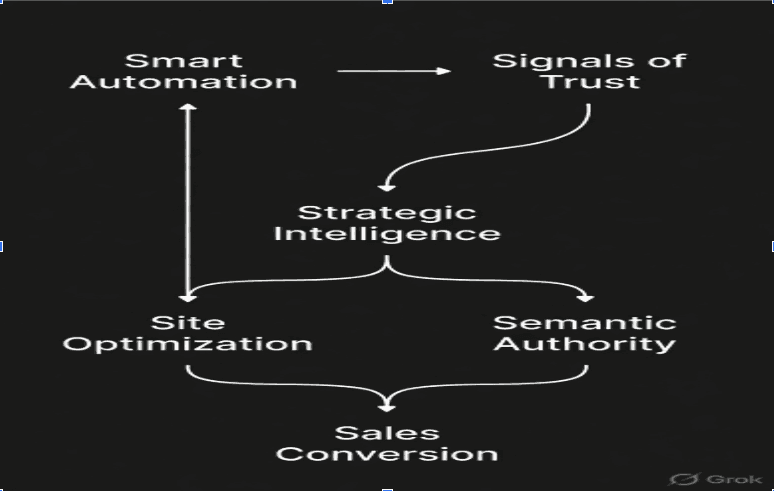
At Progbiz, we’ve poured our years of experience with AI automation and real client wins into the 6S Growth Model. Using strategic intelligence, site optimization, semantic authority, smart automation, signals of trust, and sales conversion, we make sure your business doesn’t just survive this significant shift to AI search but stands out as the most trusted voice in the room. This is not just a theory; being one of the most reputable digital marketing agencies, we’ve implemented this blueprint to increase the organic traffic significantly for e-commerce brands across Kerala. Think of it as your AI-powered compass for 2026 search dominance.
Step 1: Strategic Market & Search Intelligence
Strategy is always the foundation. Even if you’re writing a single line of content, dive deep into intent-based keyword research using AI tools like SEMrush’s AI-driven insights or Ahrefs' Topic Explorer. Map searches not by volume, but by user intent: Informational ("what is generative search optimization?"), commercial ("best AI SEO tools"), and transactional ("hire digital marketing consultants for AI SEO strategy").
Why strategy first?
Because without a solid strategy, you are just firing arrows in the dark.
A progbiz client, a Kerala-based educational institution, wasted budget on high-volume but low-conversion keywords. Our AI-assisted gap analysis revealed competitors ignoring long-tail intents, which triggered a traffic spike. Our tactical AI SEO tools earned them positions in LLM searches and AI overviews as well. Our generative search optimization didn't just get them noticed; it made sure they were the featured answer in AI overviews and LLMs (large language models). AI tools can simulate buyer journeys, predicting pain points for startup founders or marketing managers.
Data from Grand View Research confirms the scale of the AI revolution: the enterprise artificial intelligence market is expected to hit a valuation of USD 155,210.3 million by 2030, maintained by a steady 37.6% compound annual growth rate starting in 2025.
Step 2: Technical SEO & Infrastructure Optimization
Your site's backend is the silent gatekeeper of your success. In 2026, AI crawlers don't just "read" your code, they "feel" the user experience. To stay visible, your site needs to pass Google’s Core Web Vitals, which are essentially the health markers for a high-performing website. They include:
- Largest Contentful Paint (LCP): Loading Speed: This measures how long it takes for the largest piece of content on your screen, usually a big header image or the main block of text, to become visible. If this takes longer than 2.5 seconds, the page feels slow and "empty" to the visitor, even if other smaller parts have already loaded.
- Interaction to Next Paint (INP): Responsiveness (Note: INP replaced FID as the primary metric in 2024). This tracks the delay between a user taking an action, like clicking a button, tapping a link, or opening a menu, and the site actually showing a visual result. To feel "snappy" and functional, the site needs to respond in under 200 ms (or 100 ms for the initial interaction). If it's slower, the site feels broken or "frozen" to the user.
- Cumulative Layout Shift (CLS): Visual Stability: This measures whether elements on your page move around unexpectedly while the page is still loading. You’ve likely experienced this when you're about to click a link, but an image finally loads at the top and pushes the link down, causing you to click the wrong thing. A score under 0.1 means your page is "stable" and doesn't jump around.
Think of these technical scores as your brand's digital reputation. In the world of AI search, Google isn't just looking for the right keywords; it’s looking for a source it can trust to give its users a wonderful experience. If your site is sluggish or 'glitchy,' the AI sees your business as a high-risk recommendation. It won't want to cite you in its summaries if it thinks you'll frustrate the person asking the question. By cleaning up your backend, you aren't just 'fixing a site'; you’re proving to the AI that you are a reliable authority. This ensures that when our 6S Growth Model starts driving new traffic your way, your foundation is solid enough to turn those visitors into long-term customers.
Pro tip: Our team uses advanced AI audits that combine the deep-dive capabilities of tools like Screaming Frog with Google’s own performance data to find exactly what is slowing you down. For one of our retail clients, we automated this entire cleanup process. We slashed their load times almost overnight. This gave them the momentum they needed to climb back to the top of the search results and stay there.
Step 3: Semantic Content & Topical Authority Building
This is the part of the strategy where you stop chasing the competition and start leading them. To stand out in 2026, you have to move beyond the old "one keyword per page" mentality.
Instead of cluttering your site with repetitive articles that compete against each other, we focus on building topic clusters. Imagine a central pillar page dedicated to the broad world of AI content optimization. From that hub, we build out detailed clusters that dive into specifics like AI-powered SEO for e-commerce or the latest AI in marketing trends in 2026.
This approach creates "semantic coverage." By using natural language processing (NLP) tools like Surfer SEO, we make sure your content hits all the relevant entities and synonyms that search engines look for. It isn't about "stuffing" keywords anymore; it's about speaking the same language as the AI. When you cover a topic this deeply and naturally, you don't just rank for a term, you become the authority that search engines want to cite.
This is where you truly separate your brand from the noise. In the current landscape, Google has moved far beyond just matching words on a page; it now prioritizes the depth of your knowledge and the weight of your authority.
The gold standard for this is E-E-A-T, which stands for Experience, Expertise, Authoritativeness, and Trustworthiness. Think of it as your brand's digital resume. You build this by weaving in original data, insights from real experts, and a smart network of internal links that guide readers through your site.
Here, AI SEO strategy becomes your most powerful research partner. Instead of using AI to churn out generic, "spammy" articles, we use it to dig deeper. It helps us uncover the content gaps your competitors are missing, allowing you to create comprehensive deep dives that provide real value. While others are producing thin content that disappears overnight, you’re building a library of authoritative resources that stay relevant as the AI marketing transformation of 2026 continues to advance.
Case point: Wabcom, a Dubai-based Tally and business automation provider, was underperforming in search despite offering accounting software solutions for multiple industries. By building a semantic cluster around TallyPrime implementation, VAT-compliant accounting, and industry-specific automation, we expanded their topical authority. This shifted their visibility from a single keyword focus to a broader accounting software search ecosystem, resulting in stronger rankings and higher-intent business traffic.
Step 4: AI-Powered Automation & Data Optimization
What sets Progbiz apart? We connect every AI automation action directly to revenue metrics. Our AI automation services are built to transform your data into a consistent revenue stream, day or night. By setting up intelligent AI chatbots, we capture leads at the exact moment of intent. We then sync these interactions with your CRM using predictive analytics. This lets you see which prospects are actually engaging with your brand, allowing your team to focus their energy on the leads most likely to close.
When we look at data-driven marketing intelligence, we prioritize agility. We use systems that spot patterns in customer behavior to help you step in before a client drifts away, keeping your community loyal and active. For machine learning in SEO, we go beyond the visit by connecting conversion tracking directly to your content. A Progbiz e-commerce client used this precise feedback loop to automate their retargeting, resulting in a measurable jump in their total sales.
This isn't about chasing hits; it's about building a system where every new visitor has a clear path to becoming a customer.
Step 5: Authority Signals & Digital Trust Building
Google has shifted its focus from ranking websites to verifying brands. While high-quality backlinks still signal authority, unlinked brand mentions now do the heavy lifting for your off-page credibility. This organic buzz supports your reputation and provides the foundation for a modern digital PR strategy.
Structured data acts as a megaphone for your brand. By using Schema markup, you help search engines highlight your site with rich results, which naturally earns more attention and clicks. Beyond the technical side, publishing original insights on topics like 'SEO Growth Strategy 2026' defines who you are in your industry.
Why is this shift toward brand authority so important? Modern search systems favor entities with a documented track record of trust. Being a complete digital growth partner, we have helped many of our clients secure high-level mentions that turn their expertise into a lasting competitive edge. This isn't just about ranking for a day; it’s about making your brand the obvious choice for years to come.
Step 6: Conversion & Revenue Optimization
Bringing a visitor to your site is only half the battle; the real victory is turning that interest into an actual customer. In the world of AI-based marketing, traffic is a starting point, but Conversion Rate Optimization (CRO) is where you actually see the return on your investment. To achieve this, we use the AIDA framework (Attention, Interest, Desire, Action). It guides the customers naturally toward a decision, making sure your most important calls to action are visible the moment a page loads.
We take the guesswork out of your growth by using heatmaps and A/B testing to see exactly where users are clicking and where they are getting stuck. By blending these tests with specific AI automation insights, we can refine your headlines to speak directly to what your audience is searching for. To keep the momentum going, we use AI automation services like Google Ads retargeting to gently remind people about the items they left behind, effectively recovering abandoned carts and bringing shoppers back to finish their purchase.
To put these pieces together, here is the structural blueprint of the 6S Growth Model
Why Keywords Alone No Longer Guarantee Visibility
Ever wonder why so many brands are stalling despite all the AI hype? The issue isn't the technology; it's the lack of a cohesive strategy. Many businesses treat AI SEO as a "set it and forget it" tool, hoping for a quick fix that doesn't exist in today’s market. They overlook the reality of zero-click searches, or they make the mistake of flooding their site with generic, AI-generated content that triggers search penalties.
The real problem is working in silos. When you don't integrate generative AI for SEO across your entire sales funnel, you might see a spike in traffic, but you won't see a return on your investment. Following the latest Future marketing powered by AI in 2026, success now requires a brand-first approach that looks at the big picture. At Progbiz, we’ve moved past these fragmented tactics. Our 6S Model flips the script by connecting every technical detail to a clear business outcome.
Final Thought
Search engines have moved past simple keyword matching. Today, they prioritize the actual reputation of your business. The Progbiz 6S Model works by aligning your technical setup with this new verification process. We help you move from being just another link on a page to being the primary source that AI models want to cite.
We’ve applied this logic for both local Kerala startups and international brands to ensure their content reaches the right people. Instead of treating new AI updates as a barrier, we use them as the framework for your digital presence.
If you want to see how these shifts affect your specific industry, let's connect. You can book a strategy session with our team to review your current setup and identify the specific adjustments needed to keep your traffic steady. We’ll show you the exact steps to take so your business stays visible as these search systems continue to change.