
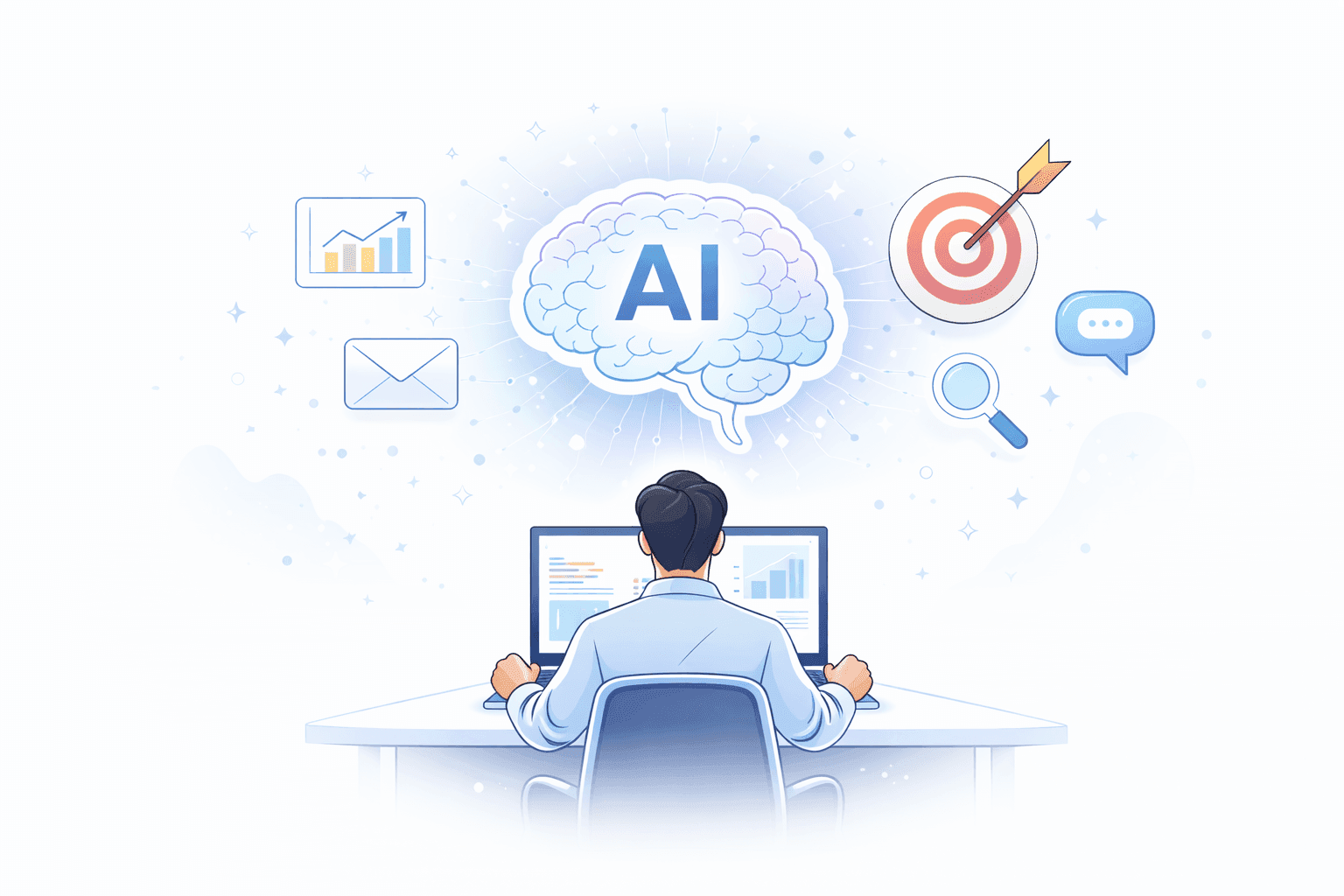
What is AI in Digital Marketing? How It is Redefining Business Growth
, with platforms like Google, ChatGPT, and HubSpot AI transforming how businesses automate campaigns and analyze customer behavior. Digital marketing looks very different from what it was just a few years ago. SEO, social media, email, and paid ads—they're all still here, but AI has quietly changed how all of them work.
Many businesses today are asking a simple question: What is AI in digital marketing, and how will it reshape marketing strategies in the coming years?
Content creation, search results, ad targeting, and campaign optimization—AI has its hands in all of it. And the businesses winning right now are the ones that have stopped fighting that shift and started leaning into it.
Many people wonder about AI vs. digital marketing, but the reality is that AI is becoming a powerful tool within digital marketing rather than a replacement for it.
To make it all work together, you need a solid foundation. That starts with five core pillars of AI-powered digital marketing that will keep your business ahead in 2026 and beyond.
The Five Pillars of AI-Powered Digital Marketing
To build a successful AI-driven marketing strategy, businesses need to focus on five core pillars:
1. AI-Driven Marketing Infrastructure: systems that automate data analysis and campaign optimization
2. AI-Optimized Search Strategy: adapting content for AI search engines and generative results
3. Intelligent Content Creation and Distribution: scaling content across multiple platforms using AI tools
4. Trust and Human-Centered Marketing: building credibility in an AI-generated content environment
5. AI-Powered Customer Intelligence and Personalization: using data to deliver tailored marketing experiences
1. AI-Driven Marketing Infrastructure
Marketing has changed a lot. AI now handles many of the heavy, time-consuming tasks that used to eat up entire workdays, and it does them instantly.
Instead of spending hours digging through spreadsheets and performance reports, your team can let AI do the heavy lifting. It spots patterns in how customers behave, predicts how a campaign might perform before you even launch it, and tells you exactly what to tweak to get better results.
That means your team gets to focus on what they're actually good at, coming up with creative ideas and building real connections with customers.
AI-driven marketing infrastructure typically includes systems such as:
- Predictive analytics tools that forecast customer behavior
- Intelligent customer segmentation systems
- Automated reporting dashboards
- Real-time campaign optimization engines
Here's a simple example: imagine a tool that watches how thousands of people interact with your website and figures out who's most likely to make a purchase. It then automatically sends those people a personalized message, adjusts how much you're spending on ads, or serves them content that actually speaks to them. No manual work. No guessing. What used to take a whole team of analysts working around the clock now happens quietly in the background, faster and more accurately than any human could manage alone.
What once required a team of analysts can now happen automatically.
Businesses that set this up gain a real edge. Their marketing moves faster, makes smarter decisions, and actually keeps up with what customers want in the moment.
That said, having the right tools is only half the story. As AI reshapes how people find information online, the way you show up in search results needs to evolve, too.
2. AI-Optimized Search Strategy
People no longer search the way they used to. Instead of typing keywords and scrolling through links, they're asking Siri, chatting with ChatGPT, or getting recommendations from apps that already know what they like.
And increasingly, they're getting direct answers with no clicking required. AI pulls the most relevant content and serves it up instantly.
For businesses that rely on search to get found, this changes everything.
That's where Generative Engine Optimization GEO comes in. Where traditional SEO was about ranking for keywords, GEO is about making sure your content shows up in AI-generated answers.
That requires a different kind of content, not keyword-stuffed articles, but material that's clear, trustworthy, and authoritative enough that AI systems actually choose to reference it.
Businesses need to concentrate on:
- Creating thorough, beneficial information that addresses actual questions
- Clearly organizing data so AI systems can understand it
- Using facts, research, and genuine ideas to demonstrate expertise
- Building a solid online reputation and brand authority
Search engines and AI assistants no longer just rank pages; they decide which sources are worth trusting. That means businesses need to move away from quick, keyword-stuffed articles and start investing in content that genuinely demonstrates expertise and credibility.
The businesses that adapt early will show up more across search engines, AI platforms, and everywhere else people discover information.
But getting found is only part of the story. How content is created and distributed is changing just as fast.
3. Intelligent Content Creation and Distribution
Content remains the foundation of digital marketing, but the way content is produced has changed significantly.
Artificial intelligence has made it possible to generate ideas, draft articles, analyze audience preferences, and repurpose content across multiple platforms within minutes.
However, the most effective brands in 2026 are not simply producing more content. They are building intelligent content ecosystems.
Instead of treating each blog post or social media update as a separate piece, businesses now transform a single insight into multiple formats that reach audiences across different platforms.
For example, one in-depth article can be adapted into:
- Short educational videos
- Social media carousels
- podcast discussions
- email newsletters
- interactive guides
- AI chatbot responses
AI makes content production faster, helping marketers spot insights, write headlines, analyze engagement, and reformat content across platforms.
But speed isn't everything. People connect with stories and real perspectives, and that still requires a human behind the wheel.
The brands winning right now aren't choosing between AI and human creativity; they're using both. AI handles the scale; humans make sure it actually means something.
This balance matters more than ever as AI-generated content continues to flood the internet.
4. Trust and Human-Centered Marketing
As artificial intelligence becomes more widely used in content creation, audiences are becoming more cautious about the information they consume.
Consumers want to know who created the content they are reading and whether they can trust it.
This is why trust has become one of the most important factors in digital marketing.
Brands that prioritize transparency, authenticity, and expertise are more likely to build long-term relationships with their audiences.
In practice, this means businesses must focus on:
- Publishing content written or reviewed by real experts
- Providing accurate information supported by data
- Being transparent about how customer data is used
- Avoiding misleading marketing tactics
- showcasing real customer experiences and case studies
AI can help brands personalize experiences and analyze data more effectively, but trust is built through human interaction and genuine communication.
Businesses that combine technological capabilities with human values will stand out in an increasingly automated digital landscape.
And when trust is established, it naturally leads to the final pillar of AI-powered marketing.
5. AI-Powered Customer Intelligence and Personalization
Every time a customer interacts with your brand, they're leaving behind clues about what they want. AI picks up on all of it, faster than any human ever could.
That means instead of sending the same message to everyone, businesses can tailor what each person sees based on their real behavior. The right recommendation, the right email, and the right advertisement delivered automatically to the right person.
Customers get content that actually feels relevant. Businesses stop wasting budget on the wrong audience.
Done right, AI turns marketing from a loudspeaker pointed at a crowd into something that feels like a real one-on-one conversation.
Examples of AI-powered personalization include:
- Product recommendations based on browsing history
- Dynamic website content that changes based on user behavior
- Automated email campaigns triggered by customer actions
- Personalized advertising based on audience segments
- Predictive models that identify potential high-value customers
This level of personalization improves the customer experience while also increasing marketing efficiency.
Customers receive more relevant information, and businesses can focus their efforts on audiences that are most likely to convert.
When implemented effectively, AI-powered customer intelligence transforms marketing from a broadcast activity into a personalized conversation.
Implementing AI-Powered Marketing: Where Businesses Should Start
The hardest part of AI in marketing isn't the technology, it's knowing where to begin.
Start simple. Bring AI into tasks you already do, like research, reporting, and automation, and keep humans involved throughout.
Create genuinely useful content, repurpose it across different formats, and let your data guide who you're talking to and how.
Most importantly, be transparent with your audience. Trust is harder to build than any campaign and easier to lose.
Start small, stay consistent, and build from there.
The Future of Digital Marketing Belongs to Intelligent Brands
Artificial intelligence is reshaping how businesses engage and understand their customers. Simply adopting AI tools will not lead you to success. It will come only when AI is used strategically to enhance creativity, improve decision-making, and deliver more meaningful customer experiences.
Businesses that want to scale faster are increasingly partnering with an AI-driven digital marketing agency that can combine automation, analytics, and creative strategy.
If you're looking to integrate AI into your marketing strategy, the team at Progbiz can help you build smarter, AI-powered marketing systems designed for the future.